

A damaged or infected tooth almost always brings up the same question at the dentist’s chair: should you save it with a root canal, or is it simpler to just get it removed? Both are common, effective treatments, but they solve the problem in very different ways.
This guide breaks down root canal vs tooth extraction so you know what to expect from each, when one is preferred over the other, and how to decide with your dentist.
What Is a Root Canal?
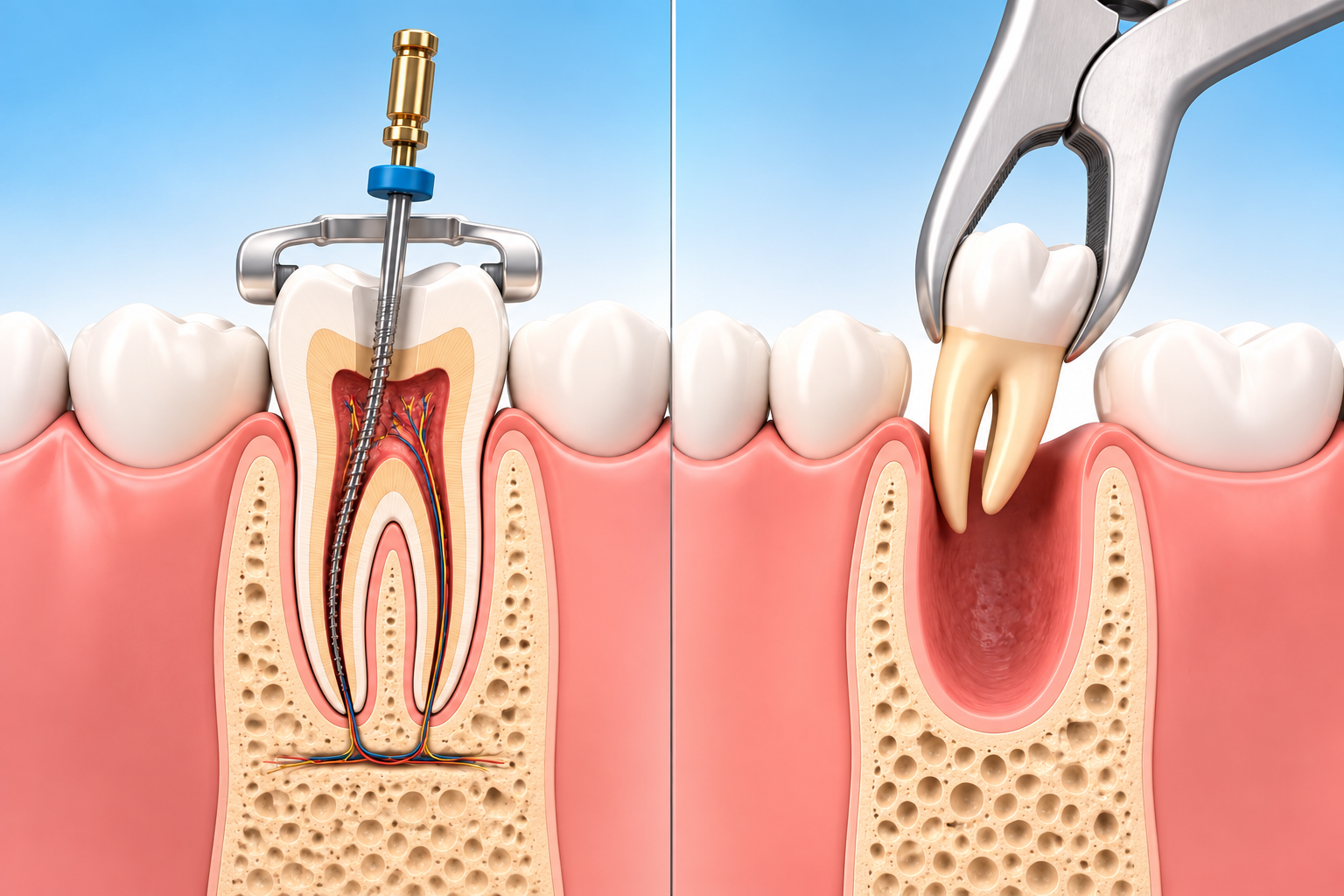
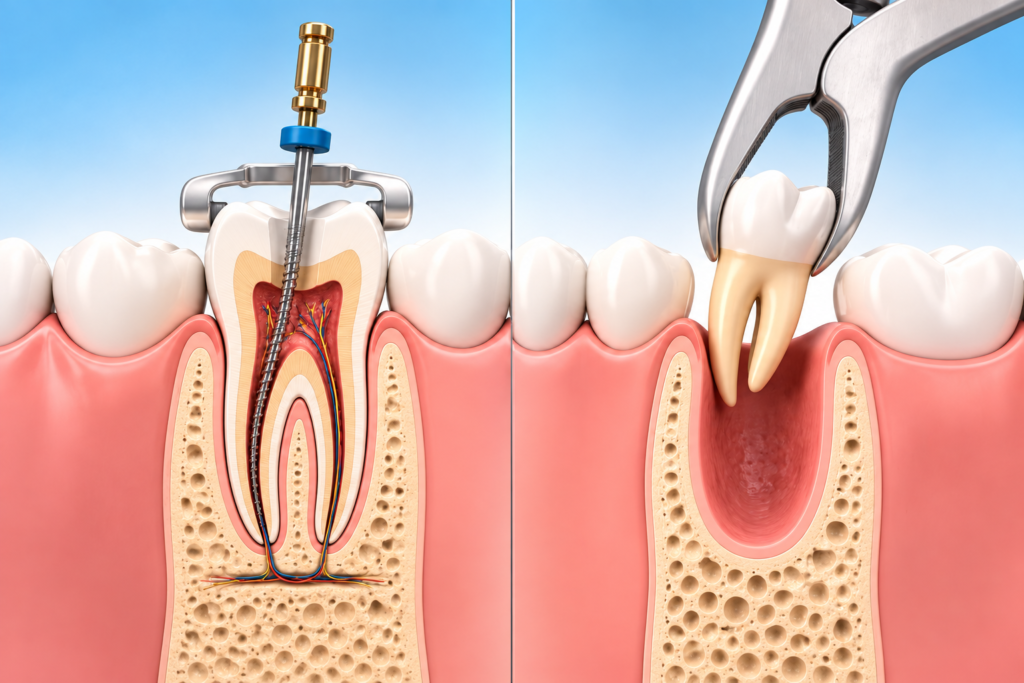
A root canal treatment removes infected or damaged pulp (the soft tissue inside a tooth) while preserving the natural tooth structure. Once the infection is cleared, the space inside is cleaned, shaped, filled and sealed, and a crown is usually placed on top to restore strength and function.
The goal is simple: save your natural tooth rather than remove it.
What Is a Tooth Extraction?
A tooth extraction is the complete removal of a tooth from its socket. It’s typically recommended when a tooth is too damaged, decayed or infected to be saved, or when it’s causing problems like overcrowding or impaction (as with wisdom teeth).
After extraction, the gap is usually filled with a replacement option like a dental implant, bridge or denture to maintain proper chewing function and prevent nearby teeth from shifting.
Root Canal vs Tooth Extraction: Key Differences
| Aspect | Root Canal | Tooth Extraction |
|---|---|---|
| What happens | Infected pulp removed, tooth preserved | Entire tooth removed |
| Natural tooth | Retained | Lost, may need replacement |
| Procedure time | One or more longer sittings | Usually quicker |
| Recovery | Mild soreness for a few days | Slightly longer healing at the socket |
| Long-term outcome | Functions like a natural tooth with a crown | Requires an implant, bridge or denture to restore chewing |
| Cost over time | Higher upfront, but often more economical long-term | Lower upfront, but replacement adds to total cost |
Signs You May Need a Root Canal
You might need root canal treatment if you notice:
- Persistent or throbbing tooth pain, especially when chewing
- Sensitivity to hot or cold that lingers well after the trigger is gone
- Swelling or tenderness in the gums near a tooth
- A darkening or discolouration of the tooth
- A small bump (abscess) on the gum
- Pain that has suddenly stopped, which can mean the nerve has died — this still needs treatment
If you’re experiencing any tooth pain treatment concerns like these, it’s worth getting examined before deciding between saving or removing the tooth.
When Is Extraction the Better Option?
Extraction is generally recommended when:
- The tooth is fractured below the gumline with insufficient structure to restore
- Decay or infection has severely damaged the tooth or surrounding bone
- There isn’t enough healthy tooth left to support a crown after a root canal
- A wisdom tooth is impacted or causing crowding
- Repeated root canal treatment has failed
- Severe gum disease has loosened the tooth beyond saving
Your dentist will usually take an X-ray to assess how much healthy structure remains before recommending either path.
Root Canal or Extraction: How Dentists Decide
When you ask “should I get a root canal or extraction,” dentists typically weigh:
- Extent of damage: How much of the tooth structure is salvageable
- Position of the tooth: Whether it plays an important role in chewing or bite alignment
- Bone support: Whether the surrounding bone and gum can support the tooth long-term
- Patient’s overall oral health: Existing gum disease or other conditions
- Cost and time considerations: Both upfront and factoring in any future replacement needed
In most cases, dentists prefer to save a natural tooth wherever possible, since nothing fully replicates its function. Extraction is considered when saving the tooth isn’t realistic or would fail again soon after.
Root Canal Treatment Cost vs Extraction Cost
Root canal treatment cost typically includes the procedure itself plus a crown afterward, since the tooth needs added strength once the pulp is removed. Extraction is usually cheaper as a standalone procedure, but if the missing tooth is replaced with an implant, bridge or denture, the combined cost can end up higher than a root canal.
It helps to think of the decision as: root canal cost = treatment + crown, versus extraction cost = removal + eventual replacement (if needed). Ask your dentist for a full breakdown of both paths before deciding.
Recovery: What to Expect
After a Root Canal
- Mild soreness for a couple of days, manageable with basic pain relief
- Avoid chewing on the treated tooth until the crown is placed
- Normal brushing and flossing can usually continue
- Full comfort typically returns within a week
After an Extraction
- Some swelling and tenderness at the socket for a few days
- Soft foods recommended initially
- Avoid smoking, straws, and vigorous rinsing to protect the healing clot
- Complete healing of the socket takes a few weeks
Why Saving Your Natural Tooth Usually Matters
Whenever it’s a viable option, keeping your natural tooth through a root canal has real advantages:
- Better chewing efficiency compared to some replacement options
- Preserves your natural bite and jaw alignment
- No need for additional restorative procedures like implants or bridges
- Maintains bone stimulation in that area of the jaw
That said, a well-planned extraction followed by a suitable replacement can also restore full function — it simply involves an extra step.
Frequently Asked Questions
1. Is a root canal more painful than an extraction?
Both are typically done under local anaesthesia, so pain during the procedure is minimal. Post-procedure discomfort is usually mild for both, though recovery patterns differ slightly.
2. Can every damaged tooth be saved with a root canal?
No. If the damage extends below the gumline, if there’s insufficient healthy structure, or if the surrounding bone is compromised, extraction may be the only realistic option.
3. Is tooth extraction cheaper than a root canal in the long run?
Not always. Extraction is often cheaper upfront, but if you need a replacement like an implant or bridge afterward, the total cost can exceed that of a root canal with a crown.
4. What happens if I don’t replace an extracted tooth?
Neighbouring teeth can shift, your bite can change, and jawbone loss can occur over time. Most dentists recommend some form of replacement.
5. How do I know if I need a root canal or extraction?
Only a dental examination with an X-ray can confirm this. Signs like persistent pain, swelling or sensitivity mean it’s time to get checked rather than guess.
6. Does a root canal weaken the tooth?
A root canal removes the pulp but not the outer tooth structure. A crown is placed afterward to restore strength, so the tooth remains functional for years.
Final Thoughts
There’s no universal answer to root canal vs tooth extraction — it depends entirely on the condition of your tooth, the surrounding bone and your dentist’s clinical assessment. Where a tooth can realistically be saved, a root canal is usually the preferred route. Where the damage is too extensive, extraction followed by a proper replacement is the better long-term choice.